
Find Lansing Residents by Record
Lansing has no single public list of every person at every address. Start with the Lansing record that answers the real question. A Lansing address or parcel number points first to the Ingham property roll. A recorded Lansing transfer belongs in the deed index. A historic Lansing surname may be easier to place in a city directory, yearbook, obituary, or probate file. A current Lansing voter-status question belongs with the state tool, while a Lansing court filing needs the county search and, when needed, the clerk's official file.
Each Lansing source has a different limit. A Lansing parcel owner may not live at the property. A Lansing court result is not identity proof. A Lansing directory can show who was listed in a particular year, not who lives there now. Match Lansing names with independent details such as a middle initial, date, parcel identifier, legal description, or sequence of moves.
- Search the Lansing-area county property route by owner, address, or parcel number when the question begins with a home or lot.
- Record the Lansing property's situs address separately from the owner mailing address, then save the parcel or PIN.
- Use the Lansing deed index for transfers and the court portal for a filing tied to the same person or property.
- Use Michigan's Lansing voter tool only for permitted registration information, and protect confidential address data.
- For an earlier Lansing household, compare directory years with maps, newspapers, probate, cemetery, or vital-record sources.
Lansing Resident Records Offices
Most Lansing resident records are held by Ingham County or Michigan offices, not by a general city directory. The county seat for Lansing research is in Mason, even though Lansing has county branch services and state offices. That Lansing-Mason split matters for older land work, because the Register of Deeds vault and its deed books are in Mason. These Lansing-area offices are the usual starting points for property, recorded instruments, and voter status.
Lansing-Area Ingham Register of Deeds
341 S. Jefferson St., second floor
Mason, MI 48854
517-676-7216
Lansing-Area Equalization and Tax Mapping
P.O. Box 319, Courthouse
Mason, MI 48854-0319
517-676-7212
Michigan Voter Information Center
Registration status for Lansing voters
Lansing clerk and polling-place details
Use the Lansing clerk route in results
Note: The Mason courthouse location is a practical Lansing access detail, particularly when an older deed or an office copy is needed.
Lansing Property Roll Clues
The Ingham property search for Lansing addresses is the useful first stop when a Lansing address is known. CADL's Lansing house-history guidance says searches can use an address, owner, or parcel number. If exact Lansing address formatting fails, try a house-number range or a street-only search. Lansing parcel and tax evidence may include the situs address, owner mailing address, legal description, assessment values, exemptions, sales history, and building details, depending on the local unit and vendor display.
Read the two Lansing address fields with care. Situs means the physical parcel. A mailing address is where tax correspondence for a Lansing parcel goes. It may belong to an owner elsewhere and does not identify all Lansing occupants. The Lansing parcel number and legal description are the stronger bridge to a recorded deed, plat, or later tax record.
Lansing Court Lookup Limits
The Ingham Court Record Search can be a useful Lansing name-based lead, but its instructions for Lansing use require a disciplined match. Search one Lansing court at a time. The first name needs at least an initial, the last or business name needs at least two initial letters, punctuation should be omitted, and a date of birth is required for Lansing criminal or traffic searches. Lansing criminal cases reach 2000, while other Circuit and Probate cases reach 1986.
Name searches for Lansing court records carry stated charges of $11 for Circuit or $10 for Probate, with a $2.50 Case Summary view. A Lansing case-number search is stated as free. The Lansing portal is not an official record. For a formal Lansing copy, use the Circuit Clerk, where research lists $1.50 per page, 90 cents per transcript page, and $10 for certification. Victim, personal-protection-order, juvenile, sealed, expunged, and other protected matters are not ordinary public results.
Lansing Voter Record Boundaries
Michigan's voter service for Lansing voters lets a person check registration status, polling place, local clerk, ballot, and election information. It is not a browsable Lansing roster for a street. A fuller Qualified Voter File request for Lansing data goes to the Michigan Bureau of Elections and can include complete name, residential or available mailing address, year of birth, registration date, status, voter ID, and requested voter history. The request process for Lansing data has its own delivery and use conditions.
The public file for Lansing voters does not include month and day of birth, phone, email, driver or state ID number, digitized signature, last four Social Security digits, or declined-registration records. Michigan does not register Lansing voters by party, and participation history is not a ballot choice. Use current Lansing status rather than drawing conclusions from an old list.
The Michigan Voter Information Center is the official starting point for Lansing status and polling information.
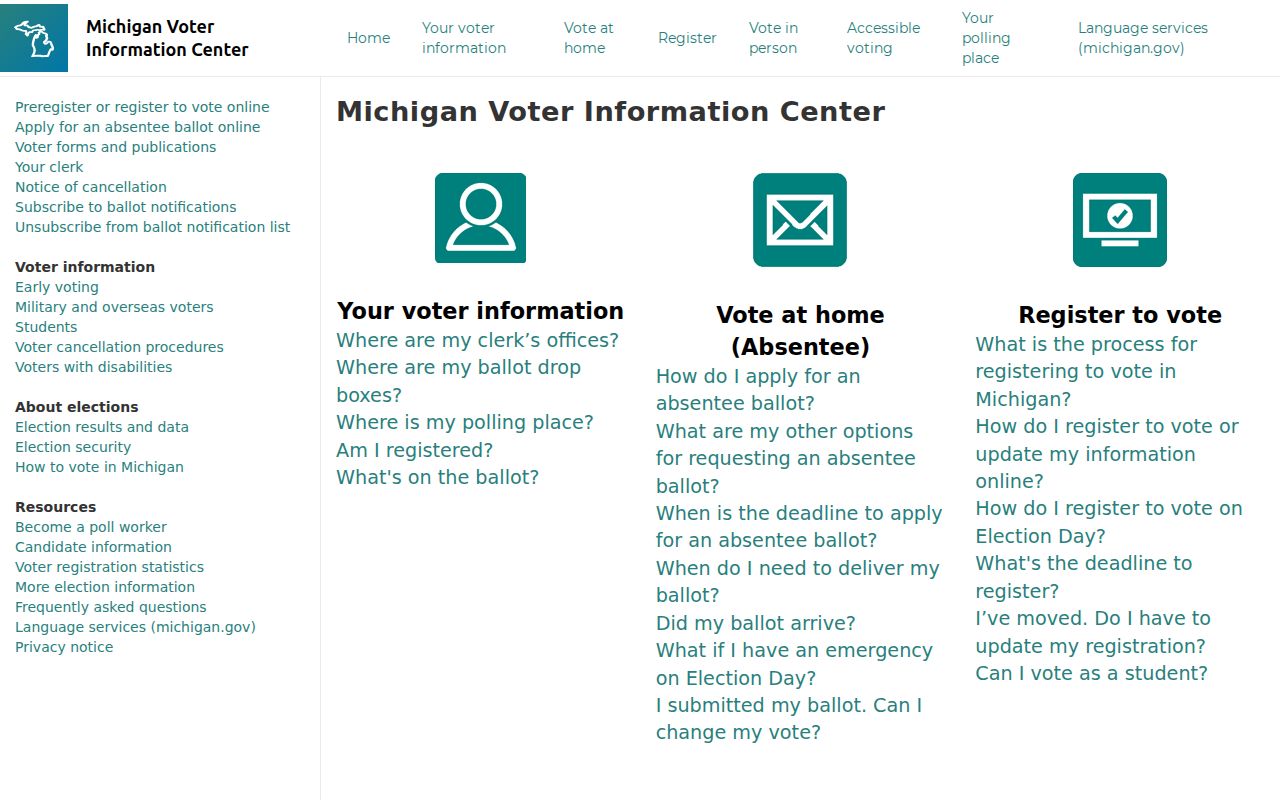
The state tool is best used to confirm permitted registration details, then paired with an independent address or record source.
Current Lansing Resident Directories
Current Lansing sources do not all list the same kind of person. The Lansing property roll tracks a record owner and parcel. The Lansing recorder tracks parties to recorded instruments. Lansing voter tools deal with registration. Lansing business and professional records may identify a public business connection, but a registered agent or license address is not automatic proof of residence. This Lansing mix is more reliable than treating one result as a full household list.
| Lansing record source | Lansing connection it can show | Custodian | Access route |
|---|---|---|---|
| Lansing property and parcel roll | Lansing owner, situs, mailing address, parcel facts | Ingham Equalization and local assessors | Lansing property portal, FetchGIS, or office |
| Lansing recorded-instrument index | Lansing grantor, grantee, document placement, legal description | Ingham Register of Deeds | Lansing free index, paid image route, vault, or mail copy |
| Lansing voter status or QVF | Permitted Lansing registration fields and history | Michigan Bureau of Elections | Lansing status lookup or formal request |
| Lansing Court and Probate files | Lansing party role, case number, filing trail | Ingham courts and clerk | Lansing portal lead and official clerk copy |
| Lansing business or license records | Lansing public entity or professional connection | Michigan LARA and county clerk | Lansing state search and custodian route |
For a name tied to one known address, the Lansing street directory route explains the parcel-to-deed chain in greater detail.
Lansing Household Record Limits
An owner name, ZIP result, or court hit is not a complete roster of people in a home. Renters and family members may not appear in a property record. Utility, delivery, and DMV address data are not public simply because an address is known. Michigan's Address Confidentiality Program protects eligible participants who use a designated address and mail-forwarding service. Courts can protect victim, juvenile, adoption, sealed, and expunged information.
Commercial people-finding services may combine public and purchased data, sometimes incorrectly. Their removal procedures do not erase the underlying county or state record. Confirm important details with the office that keeps the original record.
Lansing Vital Record Access
Michigan's vital-record office keeps records for events registered in the state from 1867, with divorce records from 1897. Birth records less than 100 years old are restricted under MCL 333.2882(1)(a). The eligible group includes the subject, named parent, guardian, qualifying representative, certain heirs with proof, or a court-ordered requester. Birth records more than 100 years old are available to any applicant under MCL 333.2882(1)(b).
Death, marriage, and divorce copies have different written-request rules under MCL 333.2882. The state lists a $34 standard search fee and a $14 online processing fee. Requests can use mail, online or phone ordering, drop box, appointment, or Will Call. A request can verify a family-history fact, but a successful order is not promised and the state issues certified copies rather than genealogy copies.
The Michigan vital-record ordering page sets out the available record types and request channels.
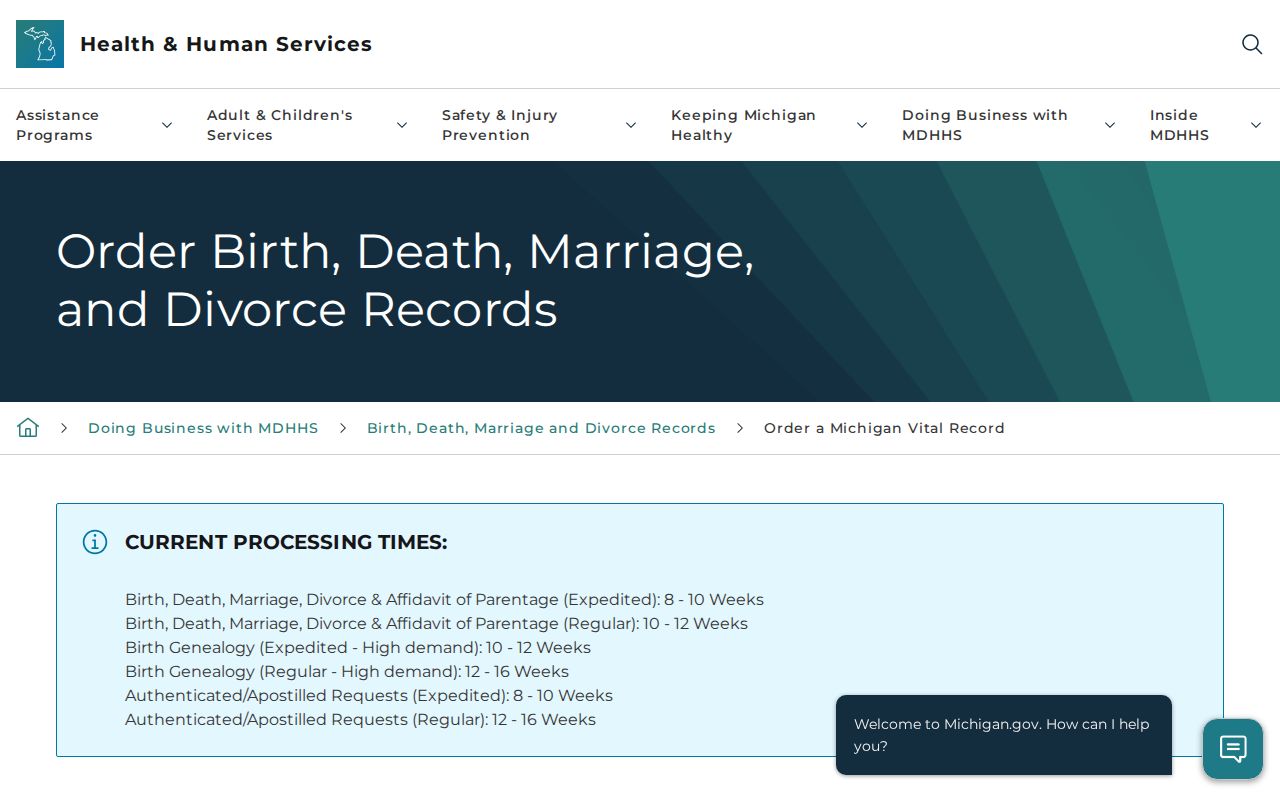
Use the record type and eligibility rule that fit the question, rather than assuming an old index and a certified record are interchangeable.
Lansing Records Lead to Mason
The county's records geography can surprise a Lansing searcher. Mason is Ingham County's seat and holds the main courthouse and Register of Deeds counter. The free Direct Search index starts in 1956 and excludes the last seven days. The county describes images from 1956 forward, while the Tapestry route describes images from 1960 forward. Conversion discrepancies remain flagged for 1956 through 1981, and the county describes 1982-forward data as accurate.
For a pre-1960 instrument, make a vault appointment to use older books and indexes, or request an identified copy by mail. Office copies are $1 per page. Tapestry lists $8.95 per search plus $1 per image page, while Laredo is subscription-based. Those separate channels matter when a free index does not settle a chain of title.
The county's online-records page explains the free, paid, office, and older-record routes.
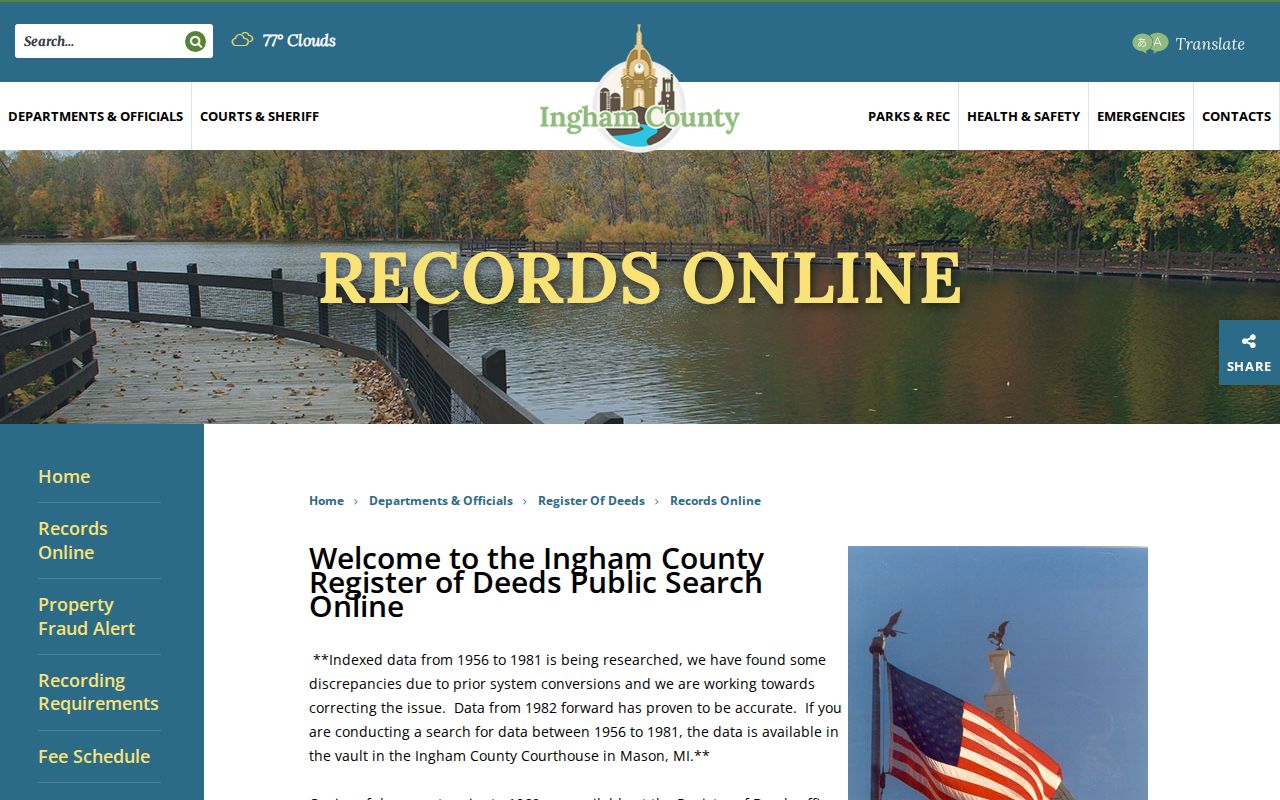
Save a book and page, document number, party role, or legal description before asking the office for a copy.
Historic Lansing Resident Directories
For past households, the city-directory shelf is unusually deep. CADL Local History holds Lansing print directories from 1867 to the present, and downtown reference holds print editions from 1911 forward. Early digitized volumes include the 1867 Smith, 1873 Brown, 1878 Pryor & Co., 1883 Polk, 1894 Chilson and McKinley, and 1904 Chilson and McKinley directories. CADL branches also provide full-text searching of directories through 1960 through Ancestry Library Edition.
Later volumes can include street listings, business listings, advertisements, and municipal material. A year-by-year run can place a household at an address, but it should be matched against deeds, newspapers, maps, or vital and probate evidence. The Lansing city directories page covers those collections and the older address systems in depth.
Lansing's 1906 Address Shift
Lansing changed address systems three times. The first system, used about 1867 to 1883, ran without block divisions or directional qualifiers. A second system appeared about 1885 to 1905, but many residential numbers still differ from current use. The Philadelphia-style block plan adopted in 1906 remains the current system, and new numbers were required on buildings beginning May 1 of that year.
That history explains many failed historical searches. A pre-1906 number should not be entered as if it were today's address. The 1913 Sanborn maps show dual numbers for some buildings and are a useful crosswalk, while the 1868 map covers Washington Avenue only. Search city directories with the full street word and try variants when CADL's digital collection returns nothing.
Lansing Local History Shelves
CADL's Local History Center combines directories with yearbooks, newspaper microfilm, permits, photographs, and real-estate material. It is at 2175 University Park Drive in Okemos, has listed Monday and Wednesday hours of 10 a.m. to 4 p.m., and accepts other appointments. The local-history team can help with a street or house-history search, and its catalog guidance recommends a full street name without quotation marks.
For a former classmate or a family lead, CADL has nearly 1,000 Lansing and Ingham school yearbooks. Its historical holdings also include the Stebbins Real Estate Collection, described as nearly 400 boxes and about 90,000 cards, and the fully digitized Belon cards from 1952 to 1970. Stebbins material is partly online or available through scan-on-demand as digitization continues.
Lansing FOIA Record Requests
When a public record has no working index, Michigan Freedom of Information Act requests can provide a defined fallback. Michigan FOIA is Public Act 442 of 1976, MCL 15.231 et seq. Ingham County accepts a written request by letter, fax, email, or its county form. Describe the specific record well enough to locate it, identify the correct custodian, and put “FOIA” in the fax cover or email subject.
The county states a five-business-day response period, with one possible 10-business-day extension. Fees can cover search, review, separation, copying, and mailing. A request is strongest when it gives an address, parcel number, document number, or a clear date range instead of asking for every record on a person.
The Ingham County FOIA summary describes response timing, fee handling, and delivery choices.
Lansing Business Record Transition
Michigan's business-record path changed in 2025 when LARA launched the MiBusiness Registry Portal. The former interface documented searches by entity name, individual name, identification number, and filing number. The new system combines searches, filings, annual reports, certificates, and copies. Searches remain useful for a public business connection, while copy and certificate orders require MiLogin for Business.
A registered agent or business address is a business contact, not proof that a person lives there. Compare an entity result with a deed, directory, or other independent public source before relying on the connection.
LARA's Corporations Division page directs researchers to the updated business portal.
The portal transition is a reminder to check a current state screen before following older filing or copy instructions.
Lansing License Record Checks
Michigan's free license search can verify a licensee, profession, issue and expiration dates, and disciplinary information. It is a narrow public record, not a broad person profile. A certified verification through MiPLUS is listed at $15 per license and requires the account process described by LARA.
Michigan license verification is the official source for that limited confirmation.
Match the license number, profession, and status rather than relying on a similar name alone.
Lansing Public Safety Records
Some official public-safety resources have their own narrow purpose. Michigan's public registry supports searches by name, registration or MDOC number, street, city, county, ZIP, and neighborhood radius, with published, incarcerated, and non-compliant browse modes. The county jail locator and state offender tools have separate coverage and should never be treated as proof of a current Lansing address or a criminal conviction.
Michigan's public registry provides the official search route and statutory-use context.
Use the official record only for its stated public-safety purpose and report errors through the designated government channel.