
Lansing Resident Lookup Record Coverage
Lansing publishes no single household roster. Instead, a Lansing resident lookup draws on records kept by city offices, Ingham County offices in Mason, and statewide custodians. The Lansing-area Ingham County Equalization property search and FetchGIS can link a recorded owner to a parcel, though the owner of record is not always the person living at the Lansing address. The Michigan Voter Information Center handles voter status and election details for Lansing voters. Court, vital, business, and license records each carry their own coverage limits and access rules. Knowing which office holds which record saves time and prevents dead ends.
| Record | What It Confirms | Where | Access coverage |
|---|---|---|---|
| Lansing property or parcel | Recorded owner, Lansing situs and mailing address, legal parcel details | Ingham Equalization and FetchGIS | Lansing public search; an owner is not automatically an occupant |
| Recorded Lansing deed | Conveyance, party role, document placement, Lansing legal description | Ingham Register of Deeds | Free Lansing index from 1956, with stated conversion issues in 1956-1981; older research uses the vault |
| Lansing court case | Party name, role, case number, type, and Lansing court connection | Ingham Court Record Search | Lansing criminal cases from 2000; other Circuit and Probate from 1986; protected matters are absent |
| Lansing voter status | Registration status, Lansing clerk, polling information | Michigan Voter Information Center | Lansing public status tool; fuller Qualified Voter File data requires a formal request and has exemptions |
| Lansing vital record | Birth, death, marriage, or divorce fact when eligibility permits | MDHHS Vital Records | Lansing events use Michigan records from 1867, divorces from 1897; birth access has a 100-year rule |
Pick the record that answers your actual question first. A parcel question belongs with Equalization or the Register of Deeds. A probate, civil, family, or criminal case question starts with the court, then the clerk. A death or marriage fact belongs with the state vital-record office. Sort questions this way. It keeps a Lansing name search from turning into a string of loose matches.
Confirm a Lansing Resident Name
Common surnames cause the most lookup errors in Lansing. Build a small identity set before accepting any result. Gather the legal spelling and its variants, a middle initial, an age or birth year where lawfully shown, the county, the address type, the party role, and a date. A shared surname proves nothing on its own. In property records, read the situs address separately from the owner mailing address. In court records, compare the court, case type, party role, and date sequence against independent evidence before drawing conclusions.
- Write down the exact Lansing name, then note maiden, married, punctuation, or spelling variants.
- Anchor the Lansing name to a parcel, deed, court role, or historical entry with a date or address.
- Compare two independent Lansing identifiers: middle initial, year, address type, case number, parcel, or legal description.
- Ask the Lansing custodian for an official or certified copy when the conclusion rests on a record.
Tracing an old classmate or a family line changes the toolset. CADL Local History holds Lansing directories, Lansing newspapers, and nearly 1,000 Lansing school yearbooks. Those historical sources can surface a middle initial, a school year, a spouse notation, or an earlier address. They do not promise a current contact detail. An heir question works differently. Start with a Probate case and a recorded deed. Then confirm the estate filing through the proper clerk. Lansing Probate coverage online reaches back only to 1986. Older estates may call for a clerk, library, or archive route.
Use Lansing Court Record Search
The Lansing Ingham Court Record Search is a solid name-based lead. It is not an official criminal-history check. Search one Lansing court at a time. The form demands a first-name initial paired with a last or business name. Use at least two letters for the name. Drop punctuation. Follow the portal wildcard rules closely. Criminal and traffic searches also require a date of birth. A separate case-number search runs without a name-search charge.
| Lansing court field | Local requirement or use |
|---|---|
| Court | Required in the Lansing portal; search one court at a time. |
| First name | Use at least an initial with the last name in a Lansing search. |
| Last or business name | Two or more beginning letters, no punctuation; the Lansing wildcard can broaden results. |
| Date of birth | Required for Lansing Criminal and Traffic searches; it still does not prove identity by itself. |
| Party and case type | Use Lansing filters to distinguish a petitioner, defendant, civil matter, or other case category. |
| Case number | Lansing alternative lookup with its own segmented format and no stated search fee. |
Name searches cost $11 per name in Circuit Court and $10 per name in Probate Court. Case Summaries run $2.50 each. Online coverage reaches Lansing criminal cases to 2000 and other Circuit and Probate cases to 1986. Personal-protection-order details and victim information stay offline. A missing result can reflect coverage gaps, privacy rules, or the wrong court. So treat it as unfinished business rather than proof of no record. The Michigan State Police ICHAT page is the official state channel. It handles a Lansing public criminal-history request.
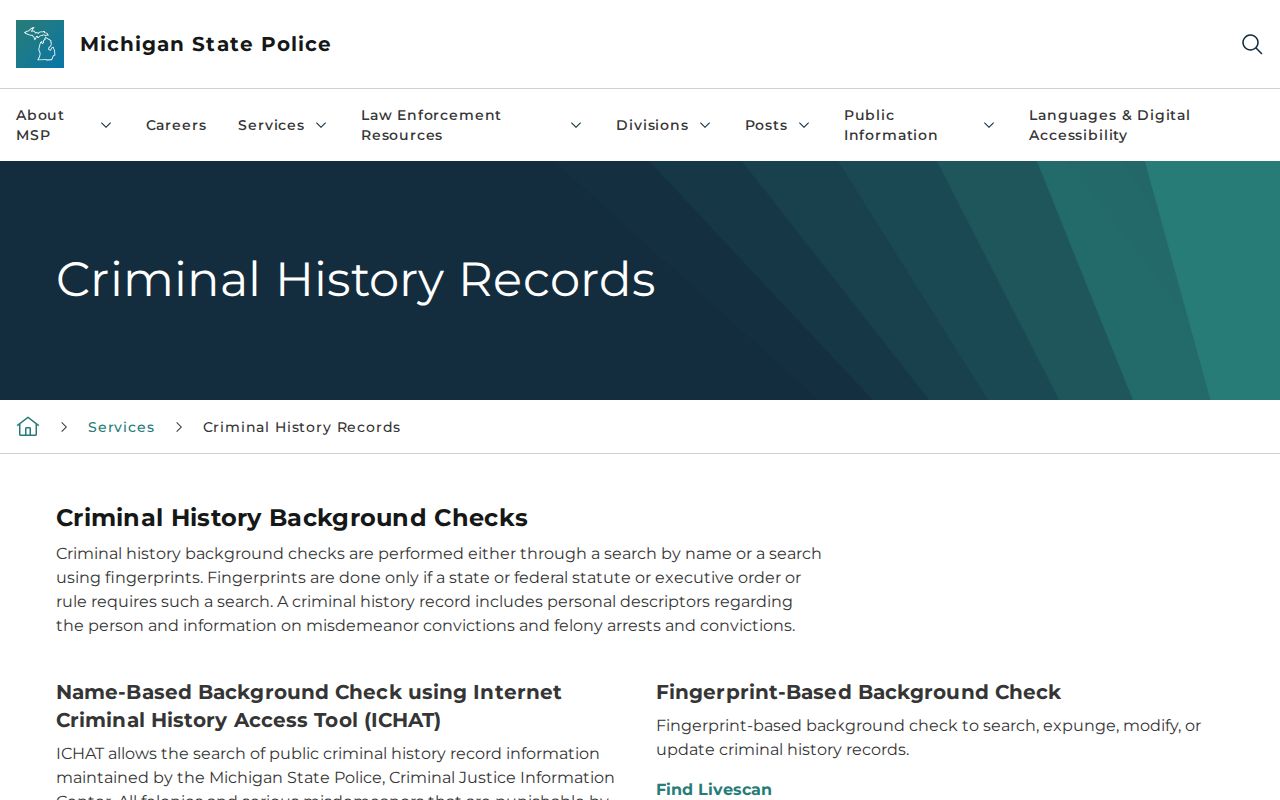
Turn to ICHAT when a formal statewide criminal-history request is required. The county court service itself distinguishes its online search from an official check.
Read a Lansing Court Record
A court result can connect a name to a filing, estate, or judgment. It does not prove identity, and it is not the official file. Victim information stays suppressed.
- Lansing party or business name and party role
- Lansing court, case number, and case type
- Case Summary purchase route and criminal-search date-of-birth criterion
Go to the official file when you need an exact copy. The Ingham Circuit Clerk names court files as the official source and posts the fees: $1.50 per page for copies, 90 cents per transcript page, and $10 for certification. Juvenile, sealed, expunged, adoption, and other nonpublic material remains closed except under the rules that govern it.
- Docket
- A docket is the court's running list of events and filings in a case, identified by a case number.
- Index versus image
- An index points to a record by name, date, or identifier. An image is the underlying scanned document or filed page, which may have separate access rules or a fee.
- Certified copy
- A certified copy is issued by the custodian with its official certification. A portal result or plain printout is not the same thing.
Note: The hearing schedule search runs as its own tool, and listed dates can shift after a result appears.
Lansing Vital Records Have Access Gates
Michigan began registering Lansing vital events in 1867, with divorce records following in 1897. Those starting dates mark coverage, not open access. Under MCL 333.2882, a Lansing birth record under 100 years old is restricted. It goes only to the subject, a named parent, a guardian, a qualifying representative, an eligible heir with proof, or someone with a court order. Once a Lansing birth record passes 100 years, any applicant may request it.
Certified copies of deaths, marriages, and divorces are available by written request. A prepaid search fee applies. The normal search fee is $34, and an online order adds $14 in processing. Genealogy copies are not issued. Orders arrive by mail, online or phone, drop box, appointment, or Will Call. The MDHHS ordering page lists current method details. The Ingham County Clerk, meanwhile, handles local transactions. It covers birth, death, and marriage in person and by mail.
Older leads are out there. The Library of Michigan vital-record guide, CADL, obituary sources, cemetery staff, and Archives holdings all help. A weekly county marriage or deceased report can point the way. It is not a certified record, though, and proves nothing about where someone lives now.
Cross-Check Lansing Resident Voter Clues
The Michigan Voter Information Center shows a voter their registration status and local clerk. It also shows polling place, ballot preview, and election details. It is not a reverse-address directory. A fuller Qualified Voter File request goes to the Michigan Bureau of Elections. It can include full name, residential and available mailing address, and year of birth. It also covers registration date, status, voter ID, and voter history when requested. Exempt fields stay exempt. Month and day of birth are exempt, and so are phone and email. Driver or state-ID number, signature, the last four Social Security digits, and declined-registration data also stay exempt.
Pair an election clue with a parcel only when independent public evidence backs the connection. Ingham Equalization links the county property search. FetchGIS supplies parcel, owner, tax, street-address, PIN, map-layer, and printing tools. These records separate a property address from an owner's mailing address. They still cannot list everyone living in a household.
Check Lansing Resident State Filings
State filings can add a date to a Lansing resident lookup. They can also add a legal name, filing number, or registered address. The Michigan MiBusiness Registry replaced the former business filing platform in June 2025. Search modes have covered entity name, individual name, identification number, and filing number. Filing and copy procedures shifted with the transition. Certificates or copies now require MiLogin for Business.
One caution applies. A registered agent is a business contact, nothing more. It proves neither ownership nor residence at that address. For professional credentials, the LARA license verification service reports licensee and profession. It also reports issue and expiration dates, and discipline. MiPLUS offers a $15 certified verification route. Weigh any state filing against a date, court number, deed, or historical directory. Do not trust one address field alone.
Request Lansing Records Beyond Portals
Portals do not hold everything. A search in the Lansing residents directory can hit a wall. The next step is a written request to the custodian of the record. Michigan's Freedom of Information Act, Public Act 442 of 1976, gives every person that right. The citation is MCL 15.231 et seq.
Describe the record well enough for staff to locate it. Ingham County accepts letters, email, fax, mail, or a county form. The usual response period is five business days. The office may take one added 10-business-day extension. Search, review, separation, copying, and mailing fees can apply.
- Name the specific record and its custodian, such as a case number for the Circuit Clerk or a document number for the Register of Deeds.
- Include enough detail to distinguish the record, such as the person, date range, parcel, address, or legal description.
- Send the request through the county's listed email, fax, mail, or form route and keep a copy of what was sent.
- Review the response for a fee estimate, deposit request, exemption, or the office that actually holds the record.
The county's FOIA summary lists its routes and timing. No request can force release of protected court files, confidential vital data, an Address Confidentiality Program address, or other exempt information.
Respect Limits on Lansing Resident Lookup
Gaps in a resident lookup are often intentional. Michigan's Address Confidentiality Program, created by the Address Confidentiality Program Act, 2020 PA 301, MCL 780.851 et seq., shields eligible participants behind a designated address with mail forwarding. Courts can also withhold victim addresses, personal-protection-order material, juvenile records, sealed records, and adoption information.
The federal Driver Privacy Protection Act keeps DMV address data out of public hands. Utility, delivery, phone, and private customer records stay private too. A street address alone makes none of them public.
Lawful use. Use public records for personal, lawful research such as family history, a probate question, civic curiosity, or verifying a record with its custodian. Never use a Lansing resident lookup to stalk, harass, impersonate, intimidate, or expose a protected person.
Public availability is not permission. Michigan's stalking statutes, MCL 750.411h and MCL 750.411i, forbid using any record to follow, threaten, or repeatedly contact someone. They also forbid using a record to harm someone. If a record looks wrong, contact the office that holds it. Never try to rebuild an ACP address from public fragments.