
Lansing City Directory Collections
Capital Area District Libraries, usually called CADL, is a main Lansing starting point. Its Local History Room holds a print run from 1867 to the present. Downtown Lansing reference holdings begin in 1911. Early digitized volumes, later print copies, and library-database access preserve the Lansing record for a first name search as well as a long Lansing family trail. The rows below distinguish named early books from continuing serial runs, because their access routes and address clues are not identical.
| Collection | Years | Where Held | Access |
|---|---|---|---|
| Smith Lansing directory | 1867 | CADL Local History | Digitized PDF and local-history access |
| Brown Lansing directory | 1873 | CADL Local History | Digitized early volume |
| Pryor & Co. / Mudge directory | 1878 | CADL and digital leads | Digitized volume; useful for first-system numbers |
| Polk directory | 1883 and continuing annual run | CADL; MSU for 1896-1941 | Print, with CADL Ancestry full text through 1960 |
| Chilson and McKinley | 1894, 1904 | CADL Local History | Digitized early volumes |
| Lansing directory print run | 1867-present | CADL Local History; downtown reference from 1911 | In person; call ahead for current shelf arrangement |
CADL reports that Lansing volumes through 1960 are searchable in full text through Ancestry at any CADL branch. The presence of a long print run does not make every edition a uniform address index. Lansing street-address listings begin in 1906, while earlier books need their own number-system and section checks.
Lansing’s Early Directory Volumes
The named books show the changing publishers behind Lansing’s printed record. Smith appears in 1867, Brown in 1873, Pryor & Co. in 1878, Polk in 1883, and Chilson and McKinley in 1894 and 1904. The 1867 book is titled Lansing City Business Directory. It should be read as a Lansing period business and civic source, not as a modern-style personal profile.
Polk later became the long-running annual serial. The catalog identifies variants including Polk’s Lansing city directory and a Polk cross-reference edition. Some Lansing editions reach beyond Lansing proper into East Lansing, Haslett, Holt, Okemos, and portions of nearby townships. Check the title page and coverage statement before deciding that a missing name means the person was outside Lansing’s wider region. Annual publication also makes neighboring editions useful for testing a short gap in a family trail. MSU Special Collections lists Polk volumes from 1896 through 1941, with later editions noted in its stacks.
CADL City Directory Access
CADL’s Local History Center serves Lansing directory work and brings together local newspapers, yearbooks, photographs, permits, and related collections. Its listed hours are Monday and Wednesday, 10 a.m. to 4 p.m., with other appointments possible. The center is at 2175 University Park Drive in Okemos, and the Local History phone is 517-367-6313. Calling first is sensible when a search depends on a specific Lansing volume or a collection that may need staff retrieval. A Lansing directory result can often be compared with Lansing newspapers and Lansing yearbooks in the same research setting.
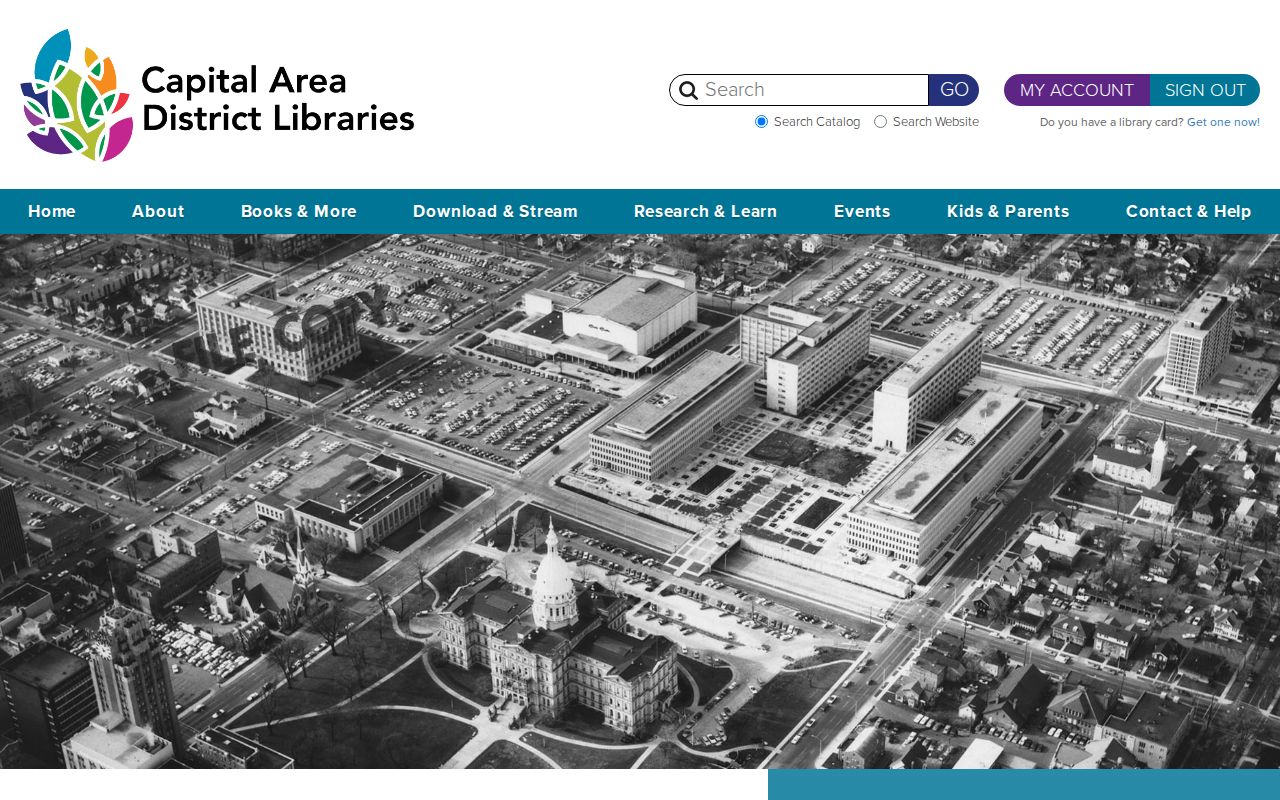
CADL’s Local History overview shows the center and its research services.
The Lansing library setting matters because a Lansing surname result may need a second source from the same Lansing collection, such as a newspaper reel or a yearbook. CADL also holds nearly 1,000 Lansing and Ingham school yearbooks, which can help place a name in a time and community without treating a single listing as final proof.
Reading a Lansing City Directory Entry
Read each Lansing source type before copying a detail. The inspected 1867 Lansing pages show business advertisements and civic text. A visible Lansing advertisement, for example, names a proprietor, a trade, Washington Avenue, and the city. That is evidence of a business and place in that volume, not a resident entry. Across the yearly Lansing books, listed people, Lansing street addresses, and occupation or business clues can be useful, but the exact field pattern changes by volume.
| 1867 business layer | Proprietor or business name, trade, street, city, and period advertising. |
|---|---|
| Listed-name layer | Annual directories list residents by last name; preserve the spelling exactly. |
| Address clue | Street name and, depending on the section and era, a number that may need translation. |
| Occupation or business clue | A useful historical identifier that should be compared with other records. |
| Abbreviations and marks | Check the volume itself. No exact 1867 abbreviation key or personal-entry code was transcribed in the research. |
- Criss-cross directory
- A later street-ordered section that can move a researcher from an address to a listed name.
- Householder index
- An index organized around listed household heads when a particular volume includes one; it is not a list of every person at an address.
- Abbreviation key
- The publisher’s front or back matter explaining its shorthand. Inspect it in the same volume rather than assuming a code from another year.
Transcribe first and interpret second. Note the Lansing book year, page, section, printed spelling, and whether the item is an advertisement, a name listing, or a street entry. The research did not expose a complete 1867 resident-page scan, so it does not support assigning spouse, ownership, or shorthand codes to that volume. A later Lansing volume may provide those details, but only its own key can establish their meaning.
Lansing Directory Number Changes
Lansing historic addresses need a date check. The first Lansing system, used about 1867 to 1883, ran south to north and west to east, with no block divisions and no directional street qualifiers. A second system, used about 1885 to 1905, added directions and block divisions, but many residential numbers still differ from today’s. The third, Philadelphia-style block plan began in 1906 and remains the current Lansing plan. New numbers were required on buildings beginning May 1, 1906.
The 1913 Sanborn maps are especially valuable because they use dual numbering. They can bridge a Lansing directory address that does not match a current Lansing parcel. Earlier Sanborn editions cover selected years, while the 1868 map documents Washington Avenue numbers only. A modern parcel search by street is a separate task, handled through the Lansing By Street directory.
Lansing Directory Search Tip
CADL’s digital Lansing Local History search rewards a literal Lansing street search. Use the full street name without quotation marks, then browse the result set. CADL’s Lansing subject headings do not abbreviate North, South, East, West, Street, Road, or Boulevard, so full words and alternate forms are more useful than a shortened Lansing address. When an exact number fails, search the Lansing street first and examine nearby results.
Insider tip. Save the old address exactly as printed, then search its full street name and a nearby number range before deciding that CADL has no related item.
For a later name that needs present-day corroboration, a Lansing resident lookup uses different records and should not be treated as a substitute for the historical volume.
Tracing Lansing City Directories
Lansing directory work is strongest when it follows one identity across several years. Begin with the Lansing surname, a middle initial when available, and the spelling used in the book. Keep a small chronology of every address and business or occupation clue. Then compare it with Lansing census schedules and Lansing map evidence. Federal schedules now publicly reach 1950, so they can anchor household relationships while intervening directory years show smaller movements.
- Find the earliest likely surname listing and record the year, spelling, street, and any printed identifying clue.
- Check the next available editions, rather than jumping straight to a distant decade.
- For 1906 and later, use the street-order section when available to compare the listed address with nearby entries.
- Pair a directory year with the nearest released federal census, then compare names, ages, and address geography.
- Use a Sanborn map or legal description when an older number will not align with the current street.
- Test a final appearance with a newspaper notice, cemetery staff, probate material, or a later deed rather than drawing a conclusion from the disappearance alone.
A missing Lansing listing can reflect a move, a changed spelling, a gap in the book, or a difference in who the publisher listed. It does not establish one explanation by itself. CADL’s Lansing newspaper microfilm and local collections provide useful comparison material, although newspaper runs have title-specific gaps.
Lansing Directory House Files
CADL’s Lansing real-estate collections add a Lansing property-focused layer beside the printed books. The Stebbins collection covers the Advance Realty era from the mid-1920s into the 1970s. CADL describes nearly 400 boxes arranged by Lansing street address, and historical-society reporting places the scale near 90,000 cards. Files may include exterior images, listings, classified clippings, and notes. Material that is not online may be scanned on demand as digitization continues.
Belon offers a useful contrast. Its 1952 to 1970 listing cards and exterior photographs are fully digitized in CADL Local History Online and arranged by Lansing street name. Stebbins was saved from disposal through local historians and later transferred from Wayne State Archives to CADL. That history explains why a Lansing address can leave evidence outside a government record series.
Other Lansing CADL collections help date the physical setting around a directory citation. Lansing City permits span 1930 to 1968, Lansing construction permits span 1923 to 1992, and the Lansing City Assessor Photograph Collection has about 17,000 exterior images from 1960 to 1980. Coverage is incomplete, and handwritten permits may have spelling inaccuracies. Treat each as supporting context for a Lansing date or address, then compare it with the original directory and map evidence.
Lansing Directory Research Partners
The Historical Society of Greater Lansing is a referral point for the wider research network. Its local-resources directory points visitors to CADL, the Archives of Michigan, MSU Archives, Lansing Community College Archives, Michiganology, digital collections, and yearbook resources. It is a practical place to identify the next custodian when a directory citation needs a map, newspaper, or archival companion.
The Historical Society of Greater Lansing local-resources list gathers several of those research paths.
MSU’s Lansing history guide also identifies Polk directories, Sanborn maps, and Lansing State Journal microfilm. Use those partners to extend a documented directory lead, while keeping the original volume, year, and printed wording in the research notes.